
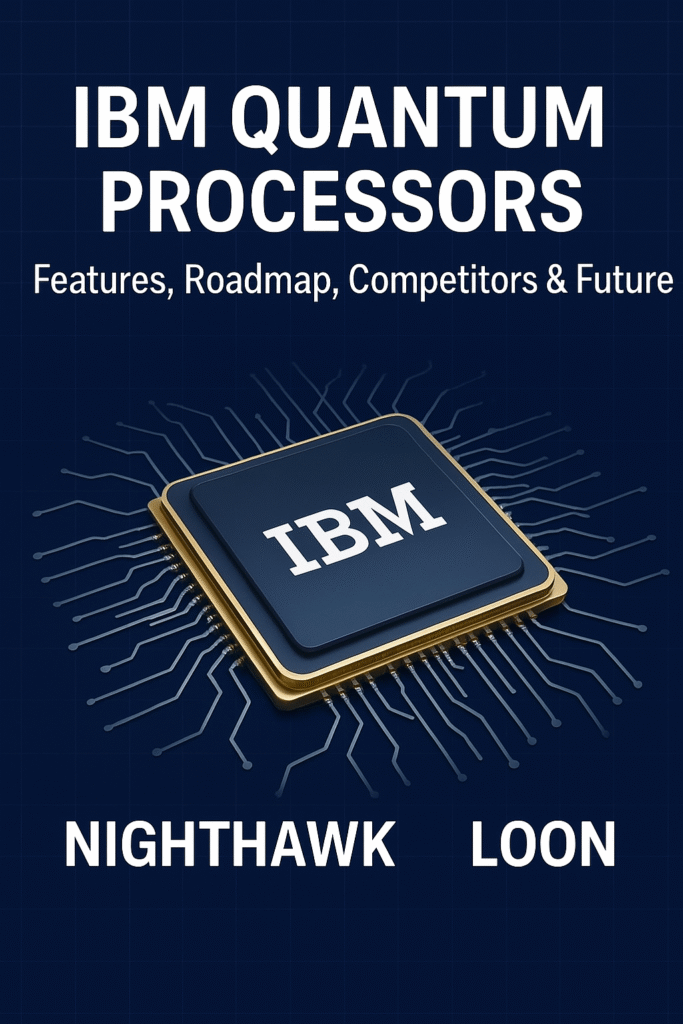
Why IBM’s new quantum processors matter
IBM Quantum Processors– recently unveiled two new quantum processors — Nighthawk and Loon — as part of a roadmap that pushes toward quantum advantage in the near term and fault-tolerant quantum computing in the coming years. These chips are important because they show concrete progress on two fronts: making quantum circuits larger and more useful today (Nighthawk), and building the hardware features needed to correct errors reliably in the future (Loon). IBM Newsroom+1
What are Nighthawk and Loon ?
Nighthawk (the “performance” chip)
Nighthawk is IBM’s high-performance quantum processor designed for more complex quantum tasks. It packs 120 qubits arranged in a square lattice and uses 218 tunable couplers to let qubits interact efficiently. The architecture targets deeper quantum circuits — reported to support work with thousands of two-qubit gates — which is a key metric for solving harder problems. In short: Nighthawk is about scaling complexity while keeping error rates manageable. IBM Newsroom
Loon (the “fault-tolerance blueprint”)
Loon is built not just to run big circuits, but to test and demonstrate the hardware building blocks that quantum error correction needs. It includes design features like longer-range couplers, reset gadgets, and richer connectivity between qubits — all useful for eventually assembling error-corrected (fault-tolerant) machines. Think of Loon as a lab prototype showing how we might fix qubit errors automatically. Live Science
Why these advances are useful
More qubits ≠ instant magic
More qubits help, but what matters is how they’re connected and how clean (low-error) they are. Nighthawk increases connectivity and circuit depth, which lets researchers try more advanced algorithms that previously would fail or be too noisy. IBM Newsroom
Fault tolerance is the real endpoint
Loon’s job is to show the pieces needed for error correction. Once we reliably correct errors, quantum machines can run long computations and solve genuinely new problems — that’s the long game IBM is aiming at. Live Science
How IBM stacks up against competitors (short comparison)
Below is a concise, reader-friendly comparison with other major players and how their approaches differ.
Google (superconducting chips, algorithm focus)
Google has pushed processor and algorithm research (Sycamore historically, and newer chips like Willow) that aim to improve fidelity and to demonstrate algorithmic speedups on specialized tasks. Google tends to pair hardware milestones with algorithmic benchmarks. blog.google
IonQ & trapped-ion vendors (all-to-all connectivity, high fidelity)
Companies using trapped-ion technology (like IonQ, Quantinuum) often have fewer qubits on paper but enjoy all-to-all connectivity and very high gate fidelity. That means certain algorithms run more accurately even with fewer qubits. These systems emphasize fidelity and mid-circuit measurement features that help error-aware workflows. IonQ+1
Quantinuum and recent breakthroughs (error-correction wins)
Quantinuum and research groups have reported systems achieving large gains in error rates and early logical-qubit demonstrations. Recent systems are showing that error correction can sometimes reach “better-than-break-even” performance in lab tasks. That’s a strong complement to IBM’s hardware roadmap, which focuses on combining qubit count, connectivity, and manufacturability. Live Science
Rigetti and others (engineering & integration focus)
Smaller specialists like Rigetti emphasize engineering advances (packaging, 3D integration) and developer access via cloud. They aim for practical developer tooling and incremental increases in qubit counts. Rigetti Computing
Bottom line: IBM’s bet is an integrated path — scale qubits and couplers (Nighthawk) while developing the hardware motifs needed for error correction (Loon) — plus industrial scale fabrication to speed up production. Competitors trade off in other ways: higher fidelity per qubit (trapped ions), different connectivity patterns, or fast algorithmic improvements.
Practical implications for developers, businesses, and hobbyists
- Developers / researchers: Expect improved access to larger circuits for testing algorithms; new software features will likely follow to make dynamic circuits and error mitigation easier. IBM
- Businesses & industries: Near-term uses will be mostly exploratory (optimization proofs-of-concept, materials simulations). True commercial advantage for common enterprise tasks still needs more progress. IBM Newsroom
- Hobbyists & learners: This is a great time to learn Qiskit basics and experiment with small circuits. When hardware scales, those skills will be in demand.
Content gaps and topics you can cover on your blog (quick ideas)
- Beginner explainer: “What is a tunable coupler?” in simple words.
- Hands-on Qiskit tutorial: migrate a small algorithm to test on IBM’s larger backend.
- Comparison post: “Nighthawk vs. Willow vs. IonQ — which is best for X?” (use plain metrics: qubit count, connectivity, fidelity).
- Security piece: explain what fault tolerance could mean for cryptography and timelines.
- Manufacturing deep dive: why 300 mm wafer fabs matter for quantum chips.
Frequently Asked Questions
8.1 What is IBM Nighthawk?
Nighthawk is IBM’s new high-performance quantum processor with 120 qubits and more tunable couplers. It’s designed to run deeper, more complex quantum circuits than earlier chips. IBM Newsroom
What is IBM Loon?
Loon is a processor built as a blueprint for fault-tolerant quantum computing. It focuses on hardware features (like reset gadgets and longer-range couplers) that make quantum error correction possible in future machines. Live Science
8.3 When will quantum computers be useful for real problems?
“Useful” depends on the problem. For niche cases (some optimization or simulation tasks), we may see early advantage within the next couple of years for specific workloads. General, reliable advantage for broad industry problems will likely require fault tolerance and comes later — IBM’s public roadmap mentions milestones through 2026 and aims toward fault-tolerance by the end of the decade. IBM Newsroom+1
8.4 How does IBM compare to Google, IonQ, or Quantinuum?
IBM focuses on scaling qubit counts plus manufacturability, Google mixes hardware and algorithm breakthroughs, IonQ/Quantinuum emphasize higher per-qubit fidelity and connectivity (trapped ions), and others emphasize engineering or cloud-first developer access. Each approach has trade-offs. blog.google+2IonQ+2
8.5 Should I start learning quantum programming now?
Yes. Basics of quantum logic and hands-on practice with Qiskit (or other SDKs) are good investments. Many early jobs will favor people who understand both the theory and the practical tooling. IBM
9. Conclusion — How to use this post
If you run a tech blog, use this post as a pillar: expand with tutorials, a “Nighthawk deep dive,” a “Loon explained for beginners,” and clear comparisons with competitor chips. Keep updating as IBM and other vendors release benchmark results — quantum is fast-moving, and fresh content ranks well.
Also read- Fixing Common Apple TV UX Frustrations: 5 Ways to Improve Navigation & Search
Your blog is a constant source of inspiration for me. Your passion for your subject matter shines through in every post, and it’s clear that you genuinely care about making a positive impact on your readers.